


Last Updated on January 31, 2026 by vitaliy
We’ve all seen Mindvalley ads. Glossy video production, coaches talking about “bending reality,” and promises of upgrading your human software. It looks great. But marketing is not the product. So are Mindvalley courses really worth your time?
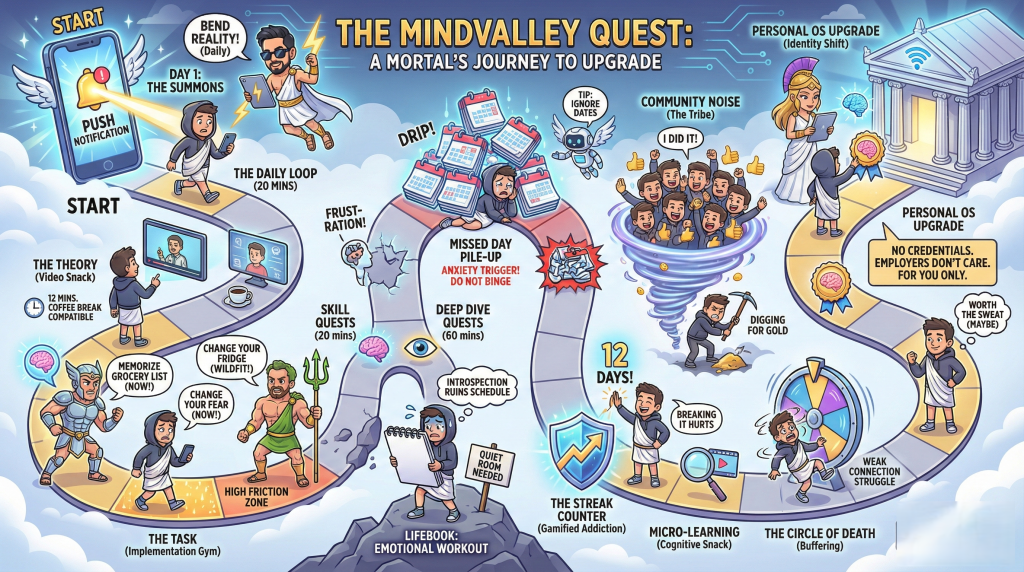
Mindvalley sells “Quests.” They don’t call them courses. Is that just branding? Partly. But functionally, a Quest behaves differently than a typical video playlist you buy on Udemy. It’s built on specific behavioral psychology principles: specifically micro-learning and spaced repetition.
Does it work? Sometimes. Is it annoying? It may be for some people.
If you are looking to learn the truth about Mindvalley, you need to look past the sales page. Here is the breakdown of what happens when you actually put your credit card down and log in.
Get $100 off Mindvalley membership
What is a Mindvalley “Quest” in Real Life?
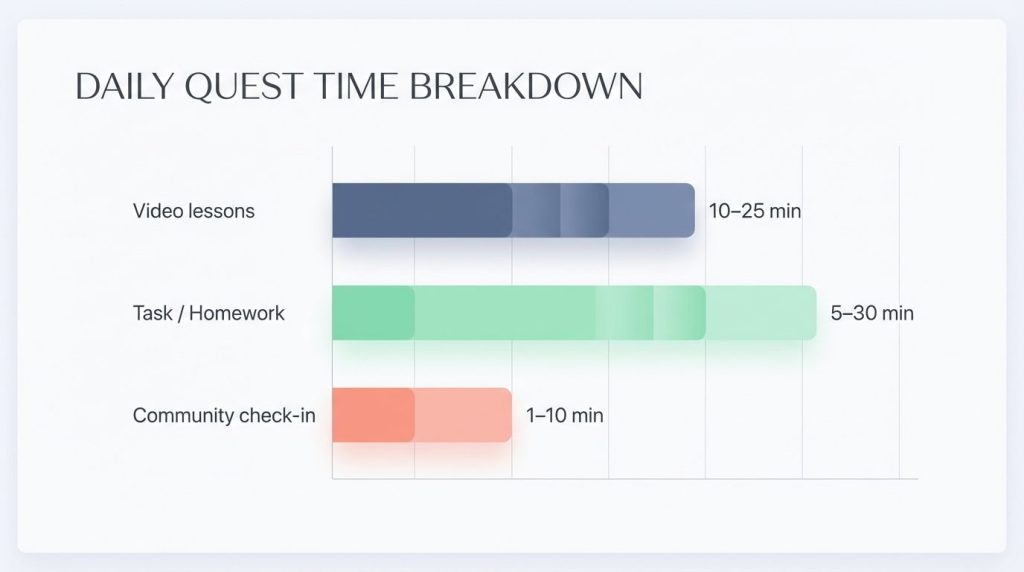
- The Theory (10–20 minutes): You watch a video. The production value is high, better than MasterClass in some aspects because the teachers talk directly to the camera, often standing up, using props. It’s very engaging, which is great.
- The Task (5–10 minutes): This is where Quests diverge from other online learning platforms. The video ends, and the app prompts a specific action. Not a quiz. Not a “select A or B.” A real-world instruction.
- The Tribe (Optional but recommended): You are nudged to post your result in the community feed. I often skip this step, though.
The whole cycle takes 20 to 30 minutes. Then you are done for the day.
The Reality: It may feel restrictive at first. You want to see what’s next. But by Day 4, you realize the restriction is the feature. It forces you to stop consuming and actually do the memory drill or the meditation. This distinct Mindvalley app experience is designed to prevent burnout.
Time commitment: How long does a Mindvalley Quest actually take?
Marketing says “15 minutes a day.” Real life says “it depends.”
A technical Quest like Superbrain really is 15–20 minutes. You watch, you drill, you leave. A psychological Quest like Conscious Parenting or Lifebook offers a different challenge. Plan for 40 to 60 minutes. The video is short, but the introspection ruins your schedule. You can’t just “listen” to Lifebook while driving. You have to sit, think, and write.
Mindvalley Quest vs. course: Structure dictates behavior
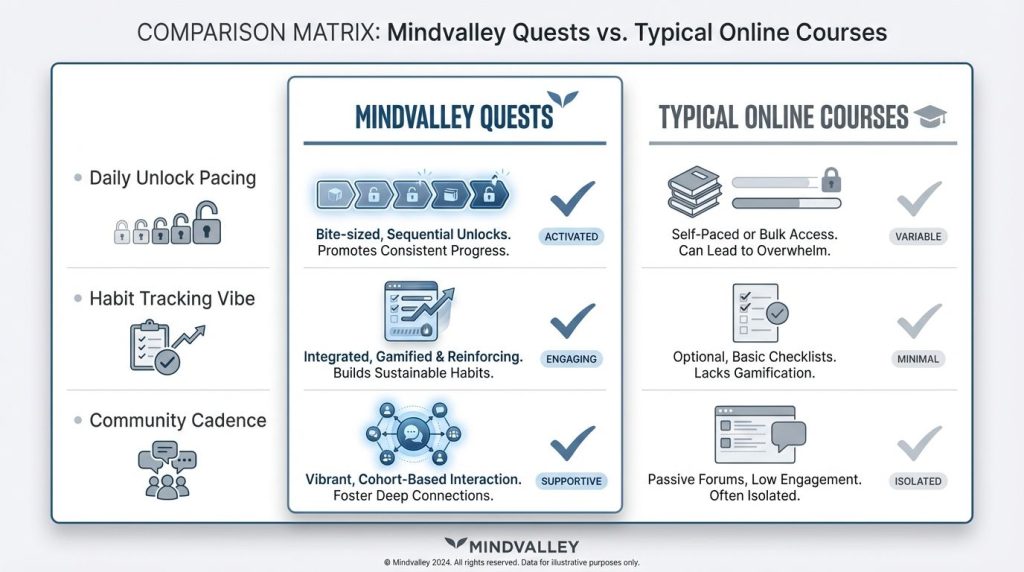
Most online learning platforms are libraries. Mindvalley is a gym class.
The Standard Course Model (The Library)
- Access: Everything at once.
- Behavior: You buy it on sale. You watch 2 hours on Sunday. You forget it exists by Tuesday.
- Completion: Low.
The Mindvalley Quest Model (The Gym)
- Access: You can take several courses at once, but it’s better to focus on one at a time,
- Behavior: You get a notification. You do one rep. You leave.
- Completion: Higher, but you need to commit.
The biggest difference is the call to action. Normal courses sell ‘understanding.’ You watch to know. Quests sell ‘implementation.’ The video is just a setup. The task is the product. If you watch the video but don’t do the breathing exercise or the journaling prompt, it won’t be worth it.
This shifts the metric from consumption to activity. This structure is a core part of the Mindvalley membership value proposition: you aren’t paying for videos; you are paying for action.
Why Mindvalley Uses “Quests”
They use three specific levers to keep you logging in. These aren’t magic; they are standard behavioral design elements.
1. Spaced Repetition
This is the scientific backbone. Brains forget 50% of new info within an hour (Ebbinghaus Forgetting Curve). By asking you to come back every 24 hours, the Quest reinforces the neural pathway before it degrades. You review the previous day’s concept briefly before starting the new one. It works. You remember more from a 30-day Quest than a 10-hour weekend seminar.
2. The Streak Counter
Simple gamification. The app shows you how many days in a row you’ve learned. It seems trivial, but breaking a 12-day streak hurts. You will log in just to keep the number green.
3. Micro-Learning
This counters “cognitive load.” A 60-minute lecture is daunting. A 12-minute video is a snack. You can fit it in while drinking coffee. It lowers the barrier to entry.
The Result: You form a habit. The content becomes secondary to the ritual of opening the app. This is how Mindvalley in 2026 continues to retain users despite the high price tag.
Completion rates: Data vs. hype
Let’s look at the numbers.
Industry Standard: Massive Open Online Courses (MOOCs) have abysmal completion rates. Research consistently pegs this between 5% and 15%. People sign up for free (or cheap), look around, and leave.
Mindvalley Stats: They claim completion rates between 30% and 50% (sometimes higher for specific programs).
Why the gap? It’s not just the quality of the video.
- Price: You paid $399 (or $299, with current discount). Sunk cost drives action. You want your money’s worth.
- The Cohort: You start on a specific date with thousands of others. Seeing 5,000 people commenting on Day 1 creates social pressure. You aren’t alone in a digital library; you are in a moving herd.
- The Lock: You can’t binge and burn out. The system paces you, preventing the “sugar rush” of learning followed by the crash.
The data suggests the “Quest” format is superior for finishing a program.
Comparing Different Quests
Not all Quests feel the same. If you check out the best Mindvalley Quests, you will notice the “daily task” varies wildly depending on the author.
Superbrain (Jim Kwik)
- The Vibe: Technical, fast, practical.
- Daily Reality: You watch Jim explain a memory trick. You practice it immediately (e.g., memorize a grocery list). You feel smarter instantly.
- Friction: Low. Easy to fit into a commute.
Wildfit (Eric Edmeades)
- The Vibe: Intense, restrictive, psychological.
- Daily Reality: This is a diet intervention. The videos are longer. The tasks require you to change what you buy and eat.
- Friction: High. This is a lifestyle overhaul disguised as a course. If you aren’t ready to change your fridge, you will quit by week 3.
Lifebook (Jon & Missy Butcher)
- The Vibe: Emotional, heavy, premium.
- Daily Reality: This is basically therapy + strategic planning. You need a quiet room. You need a notebook. You have to answer hard questions about your marriage, your finances, your beliefs.
- Friction: Very high. You cannot do this passively. It demands emotional energy.
Unique features vs. Standard features
What is Standard (Don’t be impressed by this):
- Video Quality: Yes, it’s 4K. So is YouTube.
- Speed Controls: 1.5x, 2x speed. Standard.
- Mobile App: It works, but everyone has one.
- Notes: You can type notes under the video. Basic.
What is Actually Unique:
- The “Tribe” Integration: Most courses have a dead forum. Mindvalley uses a social-media-style feed attached to each specific day. When you finish Day 4, you see the discussion for Day 4. It keeps the conversation relevant.
- Pre- and Post-Assessments: They measure you before and after. It’s a self-report, so take it with a grain of salt, but it visualizes progress.
- The “Warm Up” Audio: Many Quests start with a 5-minute guided intention setting. It primes the brain. It sounds woo-woo, but it focuses attention.
Outcomes: Mindvalley vs. Coursera vs. MasterClass
You are buying different results on each platform. Understanding this helps you answer, “Is Mindvalley worth it?“
Coursera / edX:
- Outcome: Credentials. Knowledge. Hard skills (coding, data science).
- Value: Employability.
MasterClass:
- Outcome: Entertainment. Inspiration.
- Value: You feel cool watching Gordon Ramsay, but you probably won’t become a chef. It is “Edutainment.”
Udemy:
- Outcome: Specific tactics. “How to use Excel.”
- Value: Utility. Low cost, high volume.
Mindvalley:
- Outcome: Identity shift. Belief change. Soft skills (resilience, focus, intuition).
- Value: Personal Operating System upgrade.
- The Catch: You get zero credentials. No employer cares that you finished a Mindvalley Quest. You do this for you, not your resume.
Mindvalley Flaws: Common User Problems
It isn’t all flow states and enlightenment. If you read through honest Mindvalley reviews, you see patterns of technical and structural flaws.
- The “Circle of Death”: The app handles video heavy loads. Sometimes, it just spins.
- Navigation loops: Finding a specific resource mentioned in a video can be a challenge. The “Resources” tab is often disorganized.
- Community Noise: The “Tribe” can sometimes feel like an unmoderated chaos. It’s full of people posting “I did it!” without adding value. Finding a genuine discussion is digging for gold in a pile of emojis.
- Support Delays: Customer support has improved, but if a Quest locks up, you are dealing with a bot first.
Mindvalley Pricing and Value
The cost is the biggest barrier. You need to understand the Mindvalley pricing structure before committing. It is not cheap compared to Netflix, but it is cheap compared to a weekend seminar.
If you sign up and hate the “drip feed” style, you have a safety net. The Mindvalley refund policy is automated. You click a button in your dashboard within the guarantee window (usually 15 days), and you get your money back. No emails to support required. I’ve tested it; it works.
Mindvallet offers both monthly ($49/month) and annual (399/year) membership. Right now, you can get a $100 discount if you purchase an annual subscription.
Verdict: How to pick the right Mindvalley Quest
Don’t buy based on the trailer. Buy based on your schedule.
- Do you have 20 minutes or 60 minutes each day?
- 20 mins: Go for skill-based Quests (Superbrain, Hero. Genius. Legend, The Silva Method).
- 60 mins: Go for deep-dive Quests (Lifebook, Wildfit, Conscious Parenting).
- Do you want to learn or change?
- Learn: Look for “Mastery” titles.
- Change: Look for “Transformation” titles.
- What is your “Woo” Tolerance?
- Low (Scientific): Stick to Jim Kwik, Steven Kotler, or Eric Edmeades.
- High (Esoteric): Jeffrey Allen (Energy work), Marie Diamond (Feng Shui), Vishen Lakhiani.
Mindvalley Quests are efficient behavior-change tools wrapped in slick marketing. They work if you submit to the process. If you fight the structure and try to use it like Netflix, you will waste your money. Treat it like a gym membership. Show up, sweat, leave.
Mindvalley Quests FAQ
Q: Can I download the videos for offline viewing?
A: Yes, but only inside the mobile app. You cannot download video files to your computer.
Q: Do I get a certificate?
A: You get a “Certificate of Completion.” It looks nice, but it’s functionally useless for job applications.
Q: Can I binge-watch a Quest if I want to?
A: Only if the Quest has been fully unlocked. When you first join a “live” cohort, you are time-locked. Once the cohort ends, you can often binge it, but that defeats the purpose of the design.
Q: What if I don’t like the instructor?
A: Use the refund policy immediately. If you don’t resonate with the voice in the first 3 days, you won’t make it to Day 30. Check my comprehensive Mindvalley review for more details on specific instructors.