


Last Updated on February 10, 2026 by Anna
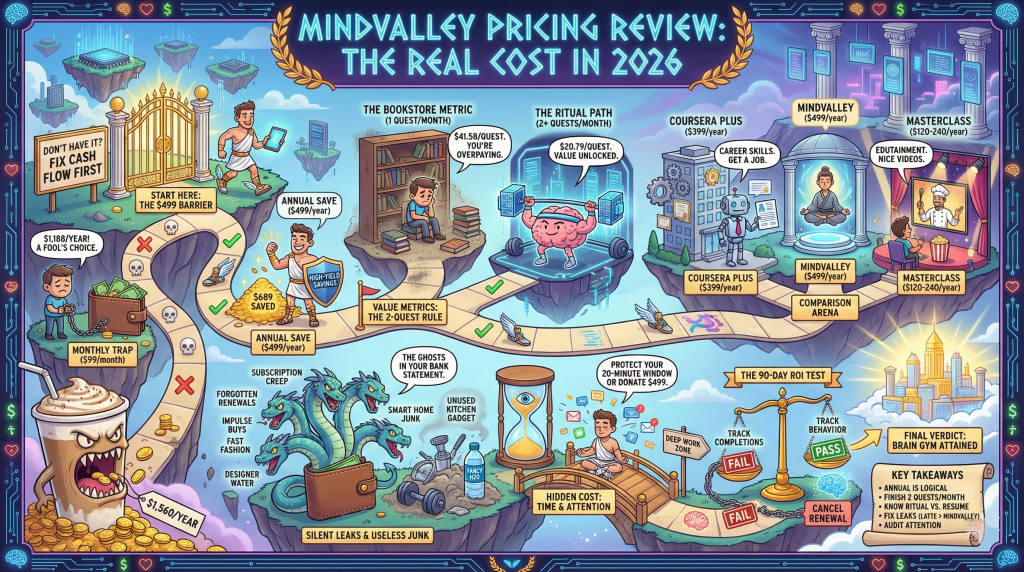
Mindvalley isn’t cheap. In 2026, the cost of an annual membership is $399 ($299 with current discount). Pay monthly? You are looking at $49 every four weeks. As you can see, the annual membership offers a much better deal.
Key Takeaways
- The 50% Save: Annual membership is much cheaper.
- The Bookstore Metric: Finish 1-2 Quests a month, or you are overpaying.
- Resume vs. Ritual: Know if you need a job (Coursera) or a habit (Mindvalley).
- Fix the Leaks: Your daily latte is more expensive than this entire platform.
- Audit the Attention: If you can’t focus for 20 minutes, the money is wasted.
Real Dollar Costs: What You Actually Pay in 2026
Mindvalley membership grants access to most programs, but some programs, like Lifebook Online are not included.
Annual vs. Monthly: The Logic of Selection
As I have already mentioned, annual subscription offers a better value. If you go with monthly plan, you will be paying much more for the “flexibility” of monthly billing. Avoid this trap. If you are unsure, use the 15-day window. Test the interface. If it doesn’t feel right, start the Mindvalley refund process immediately.
The Expensive Add-Ons Nobody Mentions
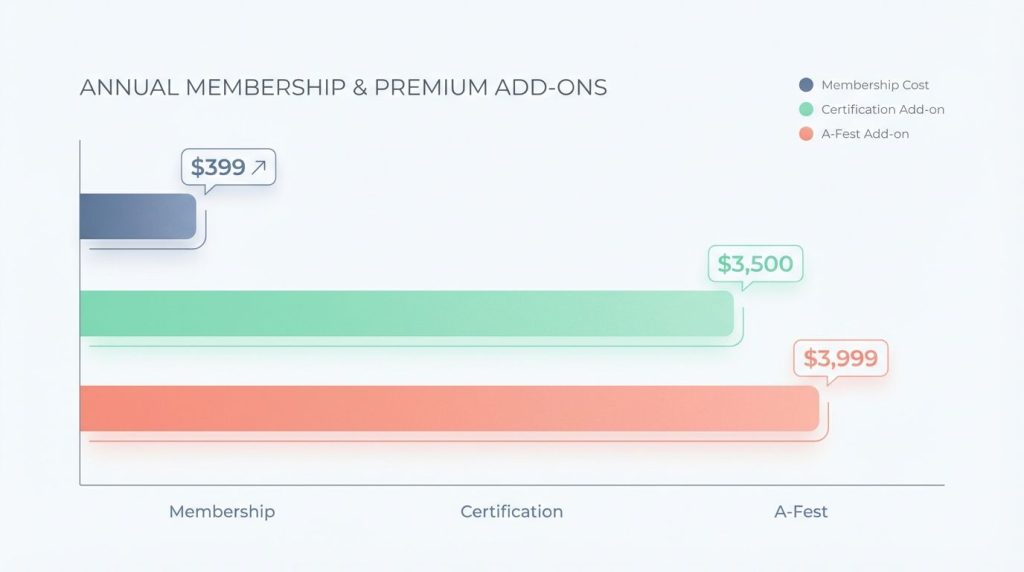
Certifications are the real revenue drivers for the platform. Want to be a certified coach? Expect to pay between $3,000 and $4,995. These are separate from your membership. Live events like Mindvalley U often start at $1,000 before you even book a flight.
Value Metrics: Cost Per Quest and Daily Usage
Break it down. $399 divided by 365 days is $1.09. This is a common marketing pitch. It is also deceptive. You don’t use the app every day of the year. Life gets in the way.
How Many Quests Make It “Worth It”?
Most Mindvalley programs last 21 to 30 days. If you finish one per month, you have done 12 in a year. That is $33.25 per Quest. A decent non-fiction book costs $25. To beat the value of a bookstore, you must complete at least two Quests per month. This brings your cost per unit to $16.6. Of course, Mindvalley programs bring much more value than most personal development books, so this comparison is not really fair.
I have analyzed the best Mindvalley Quests for 2026, and there are many great ones out there. Pick the ones with high utility. Use the search bar. Filter by “implementation,” not just “inspiration.”
Comparison: Mindvalley vs. Coursera Plus
Coursera Plus costs $399 per year ($100 more expensive with current $100 Mindvalley discount). The difference is the outcome. Coursera is for your resume. Mindvalley is for your personal development
Career Skills vs. Personal Habits
Coursera offers certificates from Google and IBM. These carry weight in a hiring office. Harvard Business Review notes that skills-based hiring is on the rise, making technical certifications highly valuable. Mindvalley offers “transformation.” Your boss won’t care if you finished “The Silva Method.” If you are unemployed or underpaid, buy Coursera. Fix your income. Only then should you look at the truth about Mindvalley and fix your mindset.
Comparison: Mindvalley vs. LinkedIn Learning
LinkedIn Learning is $39.99 a month. It is functional. It is dry. It solves immediate technical problems.
Job Performance vs. Daily Routine
LinkedIn Learning helps you fix a broken Excel formula at 3:00 PM. Mindvalley tries to change how you breathe at 6:00 AM. I value “flow.” LinkedIn is a hammer; Mindvalley is a tuning fork. If you need to stay relevant in a fast-moving market, LinkedIn is better. Statista reports that professional development is the primary driver for salary growth. Mindvalley is a luxury. Do not confuse a luxury with a necessity. However, if you can afford it, it can be life-changing.
Comparison: Mindvalley vs. MasterClass
MasterClass costs $120 per year. It is “edutainment.” You watch famous people talk about their craft.
Action Steps vs. High-Production Videos
MasterClass looks great. The lighting is perfect. The stars are world-class. But the completion rates are often low. You watch it like Netflix. Mindvalley uses “Micro-learning.” It forces you to do something every day for 20 minutes. If you want to feel inspired on your couch, buy MasterClass. If you want to change a habit, Mindvalley is the tool. My Mindvalley reviews 2026 show that the daily ritual is what justifies the higher price.
The “Silent Leaks”: Everyday Spending vs. Mindvalley
People scream about a $399 education bill but ignore the ghosts in their bank statements.
Subscription Creep and Forgotten Renewals
Check your phone now. You likely have three $15 subscriptions you haven’t opened in six months. That is $540 a year. You are paying more for “nothing” than you would for Mindvalley. Forbes highlights that subscription fatigue costs the average consumer hundreds in unused services. Cancel the fluff. Redirect that money into something that actually functions.
The Coffee and Snack Math
A $6 latte five days a week is $1,560 a year. This is three years of Mindvalley. A $15 “convenience” lunch every workday is $3,900 a year. If you say you can’t afford a membership but you eat out four times a week, your math is broken. You are choosing a sandwich over a skill. That is a poor trade. I’m blunt because it’s true. You don’t have a money problem; you have a priority problem.
Useless Things People Buy Instead of Growth
Most impulse buys end up in a drawer.
- Kitchen gadgets: Used once, then takes up counter space.
- Fast fashion: Worn twice, then discarded.
- Smart home junk: $50 lightbulbs that lose Wi-Fi connection.
- Designer water: It is literally tap water in a heavy bottle.
According to Psychology Today, impulse buying is a short-term dopamine fix that ruins long-term stability. Mindvalley aims for a 30-day dopamine cycle. It is more expensive upfront but has a longer half-life.
The Hidden Cost: Time and Attention
Money is easy to track. Attention is not. This is the part nobody budgets for.
Protecting Your 20-Minute Window
Can you find 20 minutes a day, 5 days a week? If not, the $499 is a donation to Vishen Lakhiani. Mindvalley Quests require focus. You cannot “multitask” through them and expect a result. Nielsen Norman Group’s research on attention shows that users struggle to focus on deep content when distracted by notifications. If your life is a chaotic mess of pings, fix your environment before you buy the app. The Mindvalley app review 2026 notes that the mobile experience is designed for “on-the-go” learning, but deep work still requires silence.
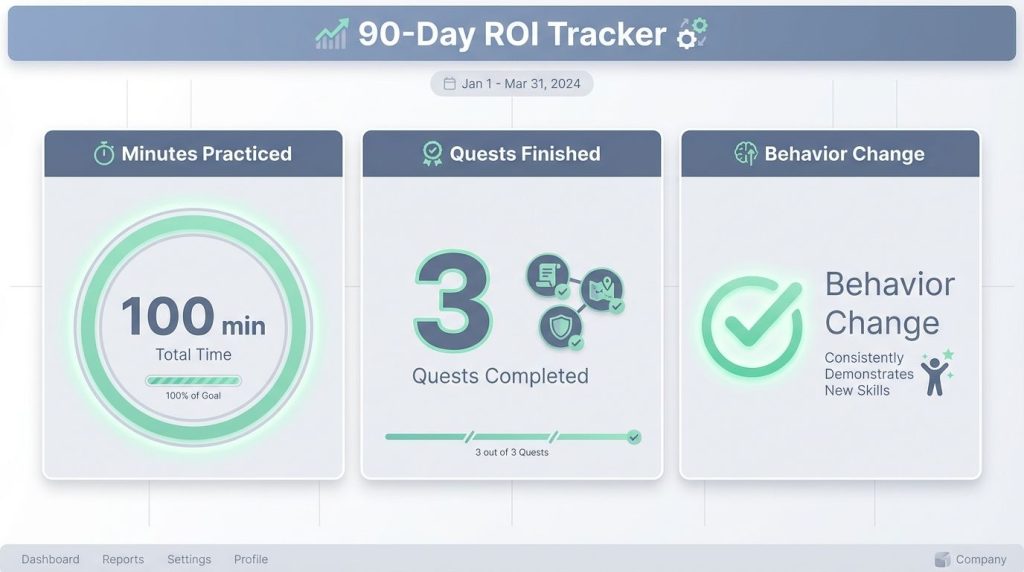
The 90-Day ROI Test: How to Audit Your Purchase
Don’t trust your gut. Trust your logs.
- Track Completions: Did you finish three Quests?
- Track Behavior: Are you sleeping better? Is your focus sharper?
- Track Spending: Did you cut $50 a month in “useless” items to fund this?
If you fail these three metrics after 90 days, cancel the renewal. You are not using the tool. Or the tool is not for you. Either way, stop the bleed. My Mindvalley review IMHO breaks down why people fail to stick with it. It’s rarely the content. It’s the lack of an audit.
Final Verdict: Who Should Buy and Who Should Skip?
Is Mindvalley worth it in 2026? Only if you treat it like a gym membership for your brain. If you have the $499 and the 20-minute daily window, it is a high-performance instrument. It beats buying “stuff.”
Skip it if you are in debt. Skip it if you think “watching” is the same as “doing.” Skip it if you need technical job skills. Go to Coursera instead. Mindvalley is a luxury investment. Treat it with the same scrutiny you would a stock purchase. Check the latest Mindvalley 2026 updates to see if new Quests fit your specific needs.
FAQ
Can I share my Mindvalley account to save money? No. The TOS forbids it. The app tracks individual progress. Sharing ruins the data and the “Quest” structure.
Is there a refund policy in 2026? Yes. You usually get 15 days. It is a “no questions asked” policy. Use it if you feel the “flow” isn’t there.
Does Mindvalley offer a free version? There is a “Quest of the Month.” It’s a marketing funnel. Try it for 30 days. If you can’t finish it, don’t buy the membership.
What is the most expensive part of Mindvalley? The coaching certifications. They can reach $4,995. These are for professionals, not casual seekers.
Is Mindvalley better than Udemy? Udemy is for one-off skills. Mindvalley is a holistic subscription. If you only want to learn one thing, buy it on Udemy for $15.