


Last Updated on February 3, 2026 by vitaliy
Many of us have bought a self-improvement subscription in the past, felt a burst of motivation for 48 hours, and then watched it turn into a monthly reminder of “I should really use that”?
This Mindvalley review is my attempt to prevent that exact outcome.
I’ve been a Mindvalley member for over six years. And over that time, I’ve seen the same pattern repeat: the platform can be great, but only for people who treat it like practice and not content.
My brutally simple rule is this: if you can commit 20 minutes a day for 30 days, Mindvalley can be worth it. If you can’t, your ROI usually drops to zero, no matter how great the courses are.
Before you subscribe, also check the refund rules, free masterclasses, and what is actually included in the Mindvalley membership (because some popular programs cost extra).
What’s the price of a Mindvalley membership in 2026?
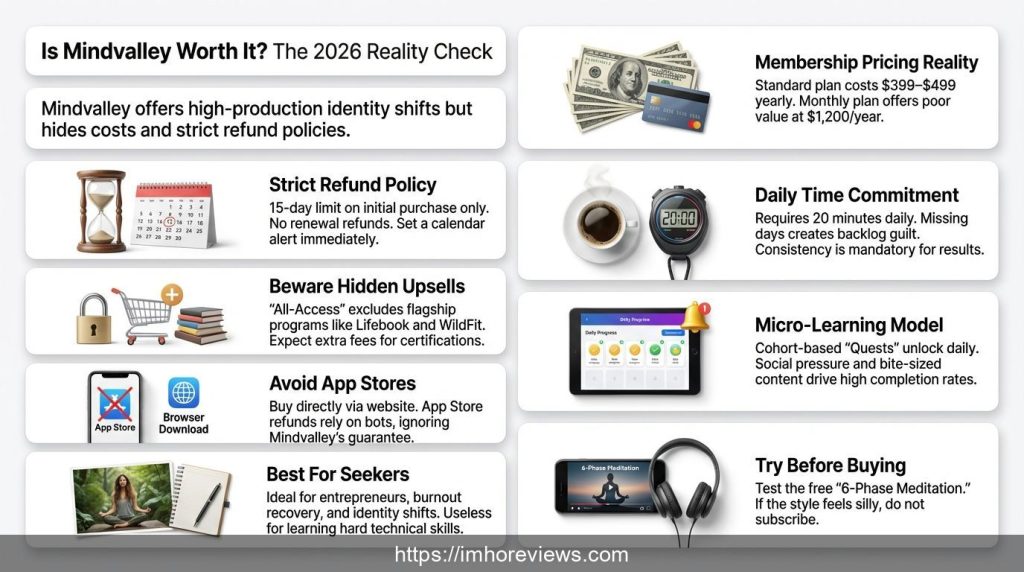
Mindvalley offers both monthly and yearly plans, and the annual plan is often discounted during promotions. Right now, you can purchase a Mindvalley membership for $49 per month or $299 per year (the regular price is $399 per year).
| Plan | Typical 2026 pricing shown | Best for | What to watch for |
|---|---|---|---|
| Monthly membership | $49/month | Testing your fit without a big upfront fee | Costs more over a full year |
| Yearly membership | $399/year (now discounted to $299/year) | People who will actually build a daily habit | Auto-renewal: renewal payments are typically non-refundable |
What makes your bill jump higher is usually not the basic membership. It’s the add-ons.
- Certifications and coach training: for example, Mindvalley lists Coaching Career Mastery pathways at $4,999 and $5,999 and a life coaching certification offer at $3,499 (payment plan options vary).
- Premium programs and events: Several well-known programs, like Lifebook Online, are not included in membership.
See if you can commit 20 minutes a day for 30 consecutive days. If you can’t hold that line, the membership can turn into a digital bookshelf you feel guilty about.
Here is what I recommend doing:
- Warm-up (3 days): pick one micro-lesson or guided meditation and do it at the same time daily.
- Choose one Quest (day 4): commit to one program only, no browsing.
- Lock the time (days 4 to 33): set a repeating calendar block, same time, same place.
- Track one metric: mood, focus, sleep, anxiety level, or a simple “did I do it” checkbox.
- Do a 10-minute weekly recap: what changed, what felt useless, and what you will adjust next week.
If you pass this test, your odds of getting real value from a Mindvalley membership go up fast. Keep in mind that Mindvalley offers a 15-day money-back guarantee on the initial membership purchase (rules can vary if you subscribe through Apple or Google). If you’re unsure it’s the right fit, either start with a monthly plan or run the steps above during your first two weeks, then decide. As you explore your options, be sure to check out the mindvalley course offerings for 2026, which are designed to enhance your personal growth journey. These courses will cover a variety of topics from mental health to productivity, ensuring there’s something for everyone. With the new year approaching, investing in your development has never been more relevant.
Most online learning fails for the same reason: people don’t finish.
A 2013 University of Pennsylvania analysis of MOOC enrollments is often summarized as roughly 4% of registrants completing courses.
If you don’t practice, the problem is never the course. The problem is the calendar.
- Access isn’t transformation: You can pay the Mindvalley membership cost and still get nothing.
- High production is not a coach: High-quality video lessons still require you to do some work.
- Too many choices kills follow-through: Starting five Quests feels productive. It usually isn’t.
Get $100 off Mindvalley membership
What’s Mindvalley actually selling: information, habits, or identity change?
In practice, Mindvalley is not selling “information.” You can get information anywhere.
It’s selling a habit engine: short daily lessons and structured programs are meant to keep you consistent.
It’s also selling identity change, the idea that if you do the reps, you start to see yourself as the kind of person who meditates, journals, speaks confidently, sets boundaries, or follows through.
| Included in the Mindvalley membership | Commonly not included |
|---|---|
| 100+ Quests and their communities | Lifebook Online |
| Live calls (and recordings, often posted within about a week) | Coach programs and certifications (example: Holobody) |
| Mindvalley Mentoring with Vishen Lakhiani | Many premium “Mastery” products and paid events |
Why the “Quest” model claims higher completion (5x better) vs. typical MOOCs around 4% to 5%
Mindvalley Quests are built around small daily actions. Many programs are designed to fit into a 10 to 30-minute window, so you finish a lesson and you still have time to do the exercise.
Mindvalley has explicitly marketed the Quest methodology as delivering 500% better completion rates. If you translate that claim into plain English, they’re saying “about 5x better” than typical online courses.
But if you want the Quest model to work, treat it like going to the gym: one program, same time, no debates.
Who is Mindvalley worth it for?
Mindvalley is worth it for people who want personal growth that crosses into career, communication, leadership, productivity, and mindset, and who actually like practice-based learning.
The winners share one trait: they use the platform as a routine, not a binge.
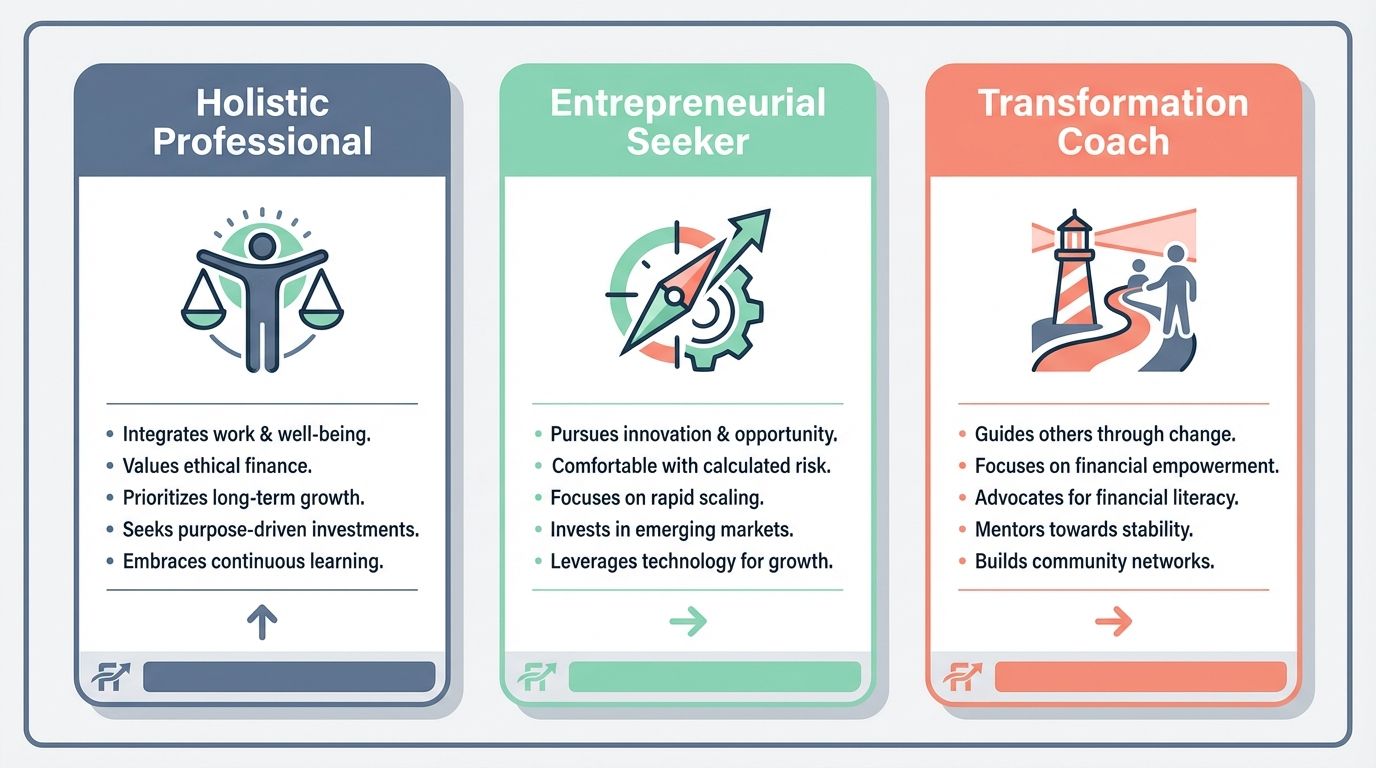
- The Holistic Professional: wants stronger habits, better relationships, more clarity, and better performance at work.
- The Entrepreneurial Seeker: wants momentum, focus, and practical routines that reduce overwhelm.
- The Transformation Coach: wants frameworks and tools to improve their own life and to help clients.
If you fit one of these, your best move is to pick a “personal” Quest and a “performance” Quest, but run them one at a time.
Who should skip Mindvalley?
If your goal is credentials, hard technical skills, or strict academic depth, Mindvalley is usually the wrong tool. And if you already struggle to finish subscriptions, Mindvalley can become a very expensive version of “maybe someday.”
- Hard-skills students: you need structured, assessed skill-building with career-recognized outcomes.
- Credential hunters: you need accredited education, not completion certificates.
- Strict skeptics of energy or manifestation: you will likely feel friction with parts of the content.
- Subscription collectors: if you rarely finish, you will not get the value.
Also, protect yourself financially. Mindvalley offers a 15-day money-back guarantee on web purchases, but renewals are generally non-refundable, and app-store purchases follow app-store rules.
Why is Mindvalley better than similar platforms?
If Mindvalley is a fit, it’s usually because the platform makes consistency easier than a typical online course library.
You get short lessons, guided practices, and the option to learn with a cohort or move at your own pace. You also get community layers inside the app.
- Micro-lessons: built for busy schedules, not weekend marathons.
- Practice-first pacing: many programs push you into action quickly.
- Community: membership unlocks the Connect tab and program networks.
Do these 3 free “pre-tests” before you spend money on Mindvalley
If you want the honest “Is Mindvalley worth it for me?” answer, do these 3 free things first:
- Test your daily meditation fit: The 6 Phase Meditation is offered as a free Quest and is structured as a 7-day program built around about 20 minutes a day.
- Test your clarity and urgency: The 3 Most Important Questions framework includes a 90-second-per-question writing rule to stop overthinking.
- Test your life-area gaps: The Lifebook Intra-spect Assessment scores 12 life categories and produces a report.
The final decision rule: what to buy instead if your goal is credentials, technical skills, or strict academic depth
If your goal is credentials, technical skills, or strict academic depth, Mindvalley is usually not the best fit.
Pick something built for assessment, then use Mindvalley for mindset, communication, personal growth, or spirituality if you still want it.
My rule is simple: buy Mindvalley when you want practice and transformation, and buy credentialed education when you need proof.
FAQs
1. Is Mindvalley worth it?
Yes, it’s worth it if you’re ready to commit.
2. What does a standard membership give you?
A standard membership gives you access to the Mindvalley library of courses. It also gives you access to some Mindvalley events.
3. How do I make the final call before I spend money on a Mindvalley membership?
Try free content first to see if it’s the right fit for you.